Showing posts with label free resources. Show all posts

Friday, May 15, 2015

Games in the Classroom! FUN! FUN! FUN!

This time of the year with test pressure behind us, lots of teachers are looking for fun ways to review or unwind. I have always loved using games in the classroom, but they can easily get out of hand or become huge time-wasters if not structured the right way. The best way I've found to structure game times is to use a timer!! This is very simple, very effective in getting a cooperative response from your students, and keeps you in a facilitative role instead of looking like the bad guy for stopping the fun!
These games are intended for grades 3-8 and include:
1. Math Madness: An Interactive Power Point Quiz Game.All answers are linked to a "Correct!" or "Oops!" page so students can play independently. (Grade Level Specific)
2. Overloaded Liters where students work through a visual representation of the place value system while earning cash for answering simple conversion problems.
3. Metric Mountain, a more advanced game that I developed for my high and gifted elementary students to practice metric conversions with decimals. This game helps students to develop an understanding of the inverse relationship between the size of pieces and amount of pieces being compared in equivalent decimal numbers such as 5 decimeters and 50 centimeters.


Sorry, this Raffle has ended, but you can still find these games by following the links below.
(These games were designed for grades 3-8 aligned to the Common Core Standards).


Visit my online store to download a free copy of Equivalent Fractions Games, a Power Point presentation that will teach your students how to add and subtract unit fractions using blocks. Templates are included so you can print your own blocks if you don't have plastic ones.


Thanks for stopping by!

Sunday, April 26, 2015

5th Grade Common Core Math Quizzes for FREE!


Last week's freebie was the 4th Grade Common Core Math Quizzes, this week 5th grade is done and posted!

Grab the 5th Grade Common Core Math Quizzes for ALL Standards for FREE before they become a paid product. The Quizzes can be used as another document of mastery in your Student Portfolio Binders, or sent home to share progress with parents.


One of the most difficult standards for me and my fifth grade students is the big jump from operations with whole numbers to operations with decimals. Fourth grade introduces adding and subtracting fractions, but in one year, fifth graders are expected to master all four operations with fractions and decimals, including visual representations. Ouch! Not to mention the other clusters! This can be tricky and students need a really solid understanding of number and place value concepts first.

Some of my favorite tools for teaching fraction and decimal operations are:
1. The National Library of Virtual Manipulatives Fraction-Rectangle Multiplication which teaches students to break apart an array into fractions along each axis, just like multiplying whole numbers. If the axes are labeled correctly, students can find fractional products really easily!
The application allows you to visually solve proper and improper fractions, as well as test students. They model the algorithm next to each rectangle array.


The only downside is that the application will not allow you to set up a 10 x 10 grid for multiplying decimals. Once students are familiar with the set-up, they could easily use graph paper to model tenths.

2. Decimal Squares
The program worksheets may look out of date, but the representations are timeless! There are different packets of skill practice that help kids build the background knowledge they need to solve decimal operations with models and algorithms.

If you're not able to purchase another program, you can use the idea of modeling spaces on graph paper. Once students can do operations in one place value (.5 + .2; .07 - .03) then they can learn to break apart multiple place values (.25 + .13) with the same operations.
I also found the idea of open arrays to help with modeling. An open array is just rectangles divided into labeled spaces by place value. It allows kids to multiply in smaller pieces and then add them together.


The 4th Grade Bundle was just published last week in my TpT store. The 5th grade Bundle will be available mid-week, once the Quiz Freebie expires.


I will announce each grade level set as it is finished, so please KEEP in TOUCH!
The quizzes will only be free for a few days, and then they will become paid products. You can see the updates on my Facebook page, my Pinterest boards, or here. Just click the "Follow Me" buttons.


                                              Thanks for stopping by!


Wednesday, April 8, 2015

Working on it Wednesday Night - FREE Quizzes for Common Core Math

Okay, most of you are in bed already, but here in Arizona I still have 53 minutes left of Wednesday! Yeah!

I usually start working when my husband comes home from work and can take the little ones; our son is 4, and our daughter is 18 months. They are adorable!!! but seem to extract every ounce of energy I have most days. If I can work until midnight without my eyes glazing over, it's a good night!!!

What have I been working on? Well, I try to honor teacher requests for materials as best as I can working part time, but I am really excited that my new Quizzes are coming along quickly! Partly because I started them in January, the free Math Quizzes by Domain - but they didn't cover enough to be helpful. If a teacher is going to have more than one way to document student learning, then the quizzes really have to represent the core skills and knowledge of each standard at grade level. These quizzes have 3-6 questions for each standard, and can be done after the pre-test, but before the post-test (if you're also using the Assessments with Learning Goals and Scales). They can be sent home for some immediate student feedback, or added to the Student Portfolio binders as extra evidence of student mastery. The content of the Quizzes represents mastery of Level 3 of the scales, since that is the grade-level expectation.

Here's the 3rd Grade Common Core Math Quizzes for ALL Standards - coming up first! Follow this link to grab your free Quizzes before they become a paid product. I plan on bundling all of my grade-level materials once the quizzes are done, but I really want to give a gift to those of you who have already been using the Math materials with Learning Goals and Scales. You shouldn't have to buy another item when new buyers will get it all in one discounted purchase. Just trying to make things fair!


I will announce each grade level set as it is finished, so please KEEP in TOUCH!
The quizzes will only be free for a few days, and then they will become paid products. You can see the updates on my Facebook page, my Pinterest boards, or here. Just click the "Follow Me" buttons.


                                              Thanks for stopping by!

Monday, March 16, 2015

Conferences and Communication

Linking up with Love Always Diana Lynn for Math Madness Monday to share my favorite products.


On  March 16, 2015,  Tonya Hackett (TpT Seller) said:

"This resource has saved me! I love using the scales as a pre and a post check. They are kid friendly and a super tool to use during parent-teacher conferences. Thanks!!"


This bit of feedback from Tonya who is using the 4th Grade Common Core Math Assessment with Learning Goals and Scales, just reminded of those days when I sat through 30 plus conferences trying to explain in 10-15 minutes what we'd been working on for the last 5 months, and how their child was doing. Until I started using my Student Portfolios I didn't have a simple tool to help you communicate student progress with students, parents, administrators, and other teachers. 

Six years ago I was working at a Title I elementary school as a gifted resource teacher 75% of the time, and a reading interventionist 25% of the time. Talk about different spectrums! Luckily for me I worked with small groups, but since my students came from five different grade levels, and there were at least 3 teachers for every grade level, communication meant a lot of data and meetings! Ugh. I'm one of those weird teachers that found staff meetings to be fun because I got to talk to other teachers! But, data meetings - definitely not fun. Lots of numbers next to each name, but no examples of student work to help understand the fine details that could shed light on why each child was performing at their own level. It seems that with all of the inclusion, clustering, interventions, and enrichment programs being implemented, most classroom teachers have a whole team of co-workers to share students with. This means that communicating about student progress doesn't just happen a few times a year, but possibly every week! 
How nice would it be to have one organized place to display student performance data that explains itself! The Math Assessments with Learning Goals and Scales plus the free Student Portfolio Pages that go with each grade level, were created to be a visual tracking aid for documenting student progress in a really simple and consistent way. Click on the video link below to flip through the 4th Grade Portfolio Sample that Tonya used for parent-teacher conferences. Visit my FREEBIES page to try them out for yourself first. Grades 3-8 are available now. Check out the work samples below!


If you'd like to see a quick tutorial about how to put together the math assessment binder with the Student Portfolio pages, visit my YouTube playlist


Saturday, March 14, 2015

Make Differentiation Easy with Learning Goals and Scales

Differentiation can seem overwhelming when you think about having to plan for 3 or 4 different levels all at the same time. I used to think about differentiation as far as high and low, but that was about it. Often I didn't end up modifying that much and I definitely didn't keep track of who started where or how far they'd progressed. Differentiation seemed like a luxury, that I didn't have time for. Until I learned to plan ahead in a more detailed way. Research shows that students who start with clear and specific learning goals can concretely SEE their progress, and will show more learning at testing time! This sounds great, but how do you organize multiple levels of performance?


Learning Goals and Scales can help!

When you create a scale, each learning goal is broken down into five levels, from 0-4. Proficiency in each math standard is represented by a score of 3. A score of 4 indicates an advanced knowledge of the skill, usually above grade level. The goals assigned to scores of 2 and 1, are either derived from sub-skills of the standard, or from the background knowledge of earlier grade levels. A score of 0 on the learning scale is useful to document for students who really need intervention to grow.

It takes some time and some thinking to put them together at first, but once it's done, it's done!! You can create scales for any subject area and make them a little more general ("I can perform any fraction operation.") or more specific ("I can add and subtract fractions with different denominators.") I found math to be the most difficult to differentiate for, so I spent the most time creating them. I also chose to focus on the standards as my main learning goal so that I wouldn't have to create a separate one for each discrete skill!
                                                                 Here's an example:

When I started posting Learning Goals with Scales for our math standards, it became more obvious to them where they were starting from and where we were headed.  

We started by informally deciding where they were based on their own opinion; "Show me on your fingers if you think you are a 1-2-3-4 right now." This worked fine to get them used to the idea, but wasn't helping me to assess or plan as much until I created some concrete Assessments with Learning Goals and Scales which presented specific tasks for each level 0-1-2-3-4, so the kids had a way to show what they knew already. I spent over 120 hours creating Math Assessments with Learning Goals and Scales for grades 4, 5, and 6, which I was currently teaching the most. I spent these hours reading, researching, and creating Learning Goals and scales for each standard that drew from previous grade levels and future grade level skills. Since I had taught so many different grade levels of math, I had a good idea where to look for standards that progressed.You can see examples of Mrs. L's Assessments by visiting my blog: http://mrslsleveledlearning.blogspot.com

I can't tell you how proud and happy they were to SEE their progress and feel like they had more than one chance to master it!!


Here's the 3 biggest benefits I found from using learning goals with scales...

1. Kids and parents will know exactly where learning and grades are coming from! After every single test, as if it were some unwritten ritual, students would brag, hide, and compare their test scores. Sound familiar? The most painful thing is to see those little jaws drop and faces turn red when they didn't score as well as they thought. "But, why did I get a 'C' Mrs. LiCausi?" (Even B's were a disappointment to those high-achievers!) I received a lot fewer questions from students, parents, and administrators when I could point out the progression of skills that a student had mastered or not, to get them to that place. When scales are aligned to specific grades, students can make a clear connection to their level of mastery and their final grade.
Visit my website to see an example of how to align traditional percentages to scales for grading!

2. Clear and specific guide for planning and assessing student progress. If you aren't lucky enough to work for a district that thoroughly plans your curriculum and mapping guides, then you know the painfully time-consuming process of sitting down with a year's worth of standards and trying to organize all those ideas, and break them down into manageable chunks for your students. The school year gets busy fast, and every time you switch topics and pre-assess your students, you're starting all over to figure out how to teach them where they're at, differentiating for different levels, and assessing again. If you've got learning goals and scales in order, the process goes so much faster because some of the thinking is done for you! You can move onto the fun part like planning and searching for awesome lessons!

3. Research supports it! Check out some of the following citations...

"The starting place for all effective instruction is designing and communicating clear learning goals."

"If teachers aren't sure of instructional goals, their instructional activities will not be focused, and unfocused instructional activities do not engender student learning.

 - Marzano [2009]


"Our collective goal is that the largest possible percentage of our students get there. To reach that goal we must define for ourselves and for them where "there" is. "

- Stiggins [1994]

"Learning targets convey to students the destination for the lesson - what to learn, how deeply to learn it, and exactly how to demonstrate their learning. In our estimation [Moss & Brookhart, 2009] and that of others [Seidle, Rimmele, & Prenzel, 2005; Stiggins, After, Chappuis & Chappuis, 2009], the intention of the lesson is one of the most important things students should learn. Without a precise description of where they are headed, too many students are "flying blind."

- Moss, Brookhart, Long [2011] Knowing Your Learning Target. Educational Leadership.  
68 [6]. pp.66-69.


Who has time to waste on ineffective approaches? 


Sunday, August 3, 2014

FREE Student Progress Portfolios *Revised*


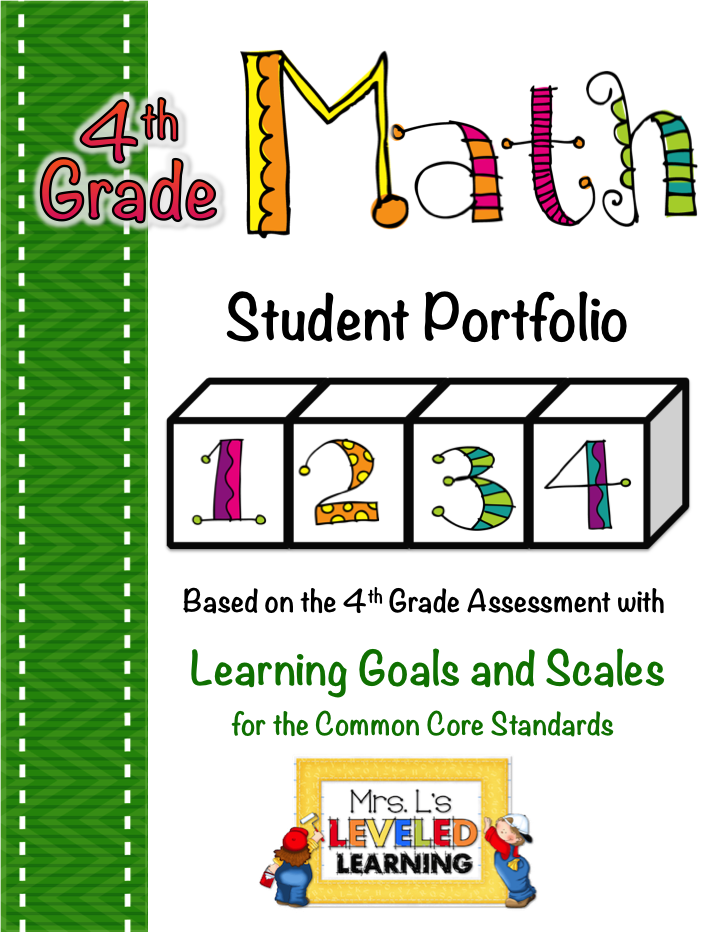
If you're one of the 1600 people who have already downloaded my FREE progress portfolios for grades 4, 5, 6 or 7; there have been some major revisions! You can return to the same link to download the revised version. My whole store and blog and are getting a face-lift this year; it's been really fun and I'm happy with the results. Please don't be afraid to leave feedback, especially suggestions for revision. Every district has different needs, and even if you're using a form of Marzano's Learning Goals and Scales in your school, it may not match my products enough to be useful for you. I'm always open to making changes. No hard feelings! I would rather it be useful than have the work sit there doing nada.

PS - I will be using my Facebook page to interact to get feedback and opinions on possible revisions or improvements for products. Please visit https://www.facebook.com/MrsLsLeveledLearning if you'd like to leave an opinion, request, or feedback. You can also send me messages through the store page. Thanks!

What will you find?  Before and Afters...


New Covers & Graphics for Every Product at Every Grade Level

        New Graphics for Every Product at Every Grade Level
          

                            Simplified Goal-Setting Sheets


Click on my FREEBIES tab to download the grade level you need for free. Thanks for stopping by!


Sunday, July 20, 2014

Top 7 Reasons to Use Learning Goals and Scales!


My three year old amuses me with his innocent assumptions. "Mom, our house leans." What? I was thinking? There are some stress cracks in the wall, but I didn't notice that. Then he goes on, "When I spin around fast. Come see...see how it wobbles a little bit." :)

Children have their own perspective; it's adorable when it doesn't matter, and a little frustrating when the standards insist that they understanding something one specific way (i.e. rectangular fraction multiplication?!) Yikes! Kids don't know what they don't know; and sometimes their self-confidence or natural ego-centrism may lead them to assume that their thinking is correct.  It's our job to get them thinking critically, to whatever capacity they can at their age level, and lead them to a more accurate understanding of things. But, how can we do this in an effective and gradual way that works from where they are at?

Learning Goals and Scales can help!

My Own Experience With Learning Goals and Scales:

When I was first asked to use Learning Goals and Scales in my classroom, I thought, "Okay, the research supports it and it seems like a good idea, but who has time to do all that work themselves?" I wasn't sure where to start. Most of the teachers I worked with were constructing their own Learning Goals as grade level teams which worked great if you had a team on-site. I was traveling between two schools, teaching three-four grade levels of math in an hour and a half a day to a multi-age advanced class, fitting in consultation time with the lower grade level teachers, and managing testing referrals and data. Every other Gifted Resource teacher in my district was in the same boat; we made a good attempt to get together, and interest was high, but follow through tapered off over a few months because we had so much to do! Language Arts seemed a lot more manageable for me, but math, with it's plethora of implied skills and vocabulary, seemed trickier to keep organized. This motivated me to start here; I spent over 120 hours creating Scaled Math Assessments with Learning Goals and Scales for grades 4, 5, and 6, which I was currently teaching the most. I spent these hours reading, researching, and creating Learning Goals and scales for each standard that drew from previous grade levels and future grade level skills. Since I had taught so many different grade levels of math, I had a good idea where to look for standards that progressed.

My students had gotten used to seeing learning goals posted on the white board everyday. I asked them to write them down at the beginning of class, and record something they learned at the end of class.

Here's an example of posted Learning Goals and Scales. 


When I introduced the Scaled Assessment as a pre-assessment, they enjoyed the fact that there was no pressure to know everything right away. They completed as much as they could, and I graded it so I could share their progress with them. The next day I would return it so they could see how far they'd gotten. Depending how much time I had, I would either return it individually, let them peruse it for a few minutes, then move onto the daily lessons; or I would return it in small groups based on performance level (1s together, 2s together, etc.) and meet with them to go over the test and skills. I would usually spend time going over the next skills so they would have an immediate goal to focus on in class. I would only fit in a meeting with each group about once a week, but it was better than nothing. The kids seemed really motivated to progress and felt like they were 'cheating' because they got to see the test in advance.

I used the same exact test as a post-assessment, and the kids really loved being able to see the scales they'd already mastered and skip ahead to finish the test faster! Those who had gotten really far only had to complete scales 3-4. Those who had more to learn, had more work to do, but this was okay because it also helped me to manage the environment. I would have 1-2 "When You're Done..." activities up on the board for the kids I knew would be done quickly. I made sure there were quieter areas of the room for the kids who would need the whole period to finish.

I didn't feel like I was letting the kids "cheat" because first of all, there were usually 2-4 weeks between the time they took the assessment as a pre-test, and a post-test. It was very unlikely they were going to remember the problems. Secondly, kids learn through repetition and practice, and the more they get to see and hear the learning goals and examples, the more likely they will be conscious of their learning. When kids are conscious of their learning, they are much more likely to take ownership of it! THIS IS THE GOAL! Teach kids to realize that they have charge of their learning, not just me! 

I can't tell you how proud and happy they were to SEE their progress and feel like they had more than one chance to master it!!

1. Learning goals and scales help kids see a concrete progression of skills, instead of making their own assumptions about where they are going, and how far along they've come. An informal way of implementing this is to ask your students, "Here's our learning goal today...show me on your fingers where you think you're at with converting fractions to decimals...0...1...2...3...or 4?" This is fine if it helps you make an immediate decision about where to begin instruction or review. But, how reliable is a student's opinion if they don't have the same frame of reference that you do? Do they understand what concepts they've learned that have set them up for successful comprehension of this skill? Do they know where their going with it, or what its purpose is? How many of us as adult can evaluate ourselves when we don't know what we don't know!

2. Kids love affirmation! Don't we all! My experience in child development education and early elementary teaching has taught me that specific praise, is much more effective than general praise because it helps a child see their locus of control as internal, instead of external. Instead of saying "Good Job for getting an A on this test Janie!", and Janie walking away thinking, "Yeah, I'm really lucky! I wonder how I did that?!"; you can say, "Janie, on your pretest you could only add fractions with the same denominator using blocks, now you can add fractions with any denominator and explain how! Excellent work!" Janie can walk away thinking, yeah, I really learned something!"

3. Kids will know exactly where their learning and grades are coming from! After every single test, as if it were some unwritten ritual, students would brag, hide, and compare their test scores. Sound familiar? The most painful thing is to see those little jaws drop and faces turn red when they didn't score as well as they thought. "But, why did I get a 'C' Mrs. LiCausi?" (Even B's were a disappointment to those high-achievers!) I received a lot fewer questions from students and parents when I could point out the progression of skills that a student had mastered or not, to get them to that place. When scales are aligned to specific grades, students can make a clear connection to their level of mastery and their final grade.

4. Clear and specific guide for planning and assessing student progress. If you aren't lucky enough to work for a district that thoroughly plans your curriculum and mapping guides, then you know the painfully time-consuming process of sitting down with a year's worth of standards and trying to organize all those ideas, and break them down into manageable chunks for your students. The school year gets busy fast, and every time you switch topics and pre-assess your students, you're starting all over to figure out how to teach them where they're at, differentiating for different levels, and assessing again. If you've got learning goals and scales in order, the process goes so much faster because some of the thinking is done for you! You can move onto the fun part like planning and searching for awesome lessons!

5. Parent communication is greatly enhanced when they really know what their child is doing! How many parents remember what they learned in elementary or middle school math? How many skills or vocabulary terms are still fresh in their mind? I found that sharing the learning goals and scales with my parents, allowing them to see the student portfolios with their child's assessments and some key classroom assignments,  make things more clear to them . They were more cooperative if their child needed help, and more confident that they knew what their child and I were doing all day.

6. Administrator observations and evaluations go much more smoothly when you can show that you have a concrete plan of assessment and differentiation for the standards. How great would it be to have your administrator walk into your room and say, "Wow, you really have things organized!" or "Wow, I can see exactly what you are assessing your students on, and I will fully support you in doing what you want to get them proficient!" Most of us want to be more than competent, we want to be inspirational! We want to see kids light up with pride and enthusiasm, and be recognized for making that happen. I know I felt the most satisfied in my job when I was trusted enough to have the freedom to try new things, new curriculum, or new methods. In my experience, when I developed professional credibility, I was recognized and supported by administrators and peers in doing things the way I wanted to. I enjoyed teaching more, and felt more confident in what I was doing.

7. Research supports it! Check out some of the following citations...

"The starting place for all effective instruction is designing and communicating clear learning goals."

"If teachers aren't sure of instructional goals, their instructional activities will not be focused, and unfocused instructional activities do not engender student learning.

 - Marzano [2009]


"Our collective goal is that the largest possible percentage of our students get there. To reach that goal we must define for ourselves and for them where "there" is. "

- Stiggins [1994]

"Learning targets convey to students the destination for the lesson - what to learn, how deeply to learn it, and exactly how to demonstrate their learning. In our estimation [Moss & Brookhart, 2009] and that of others [Seidle, Rimmele, & Prenzel, 2005; Stiggins, After, Chappuis & Chappuis, 2009], the intention of the lesson is one of the most important things students should learn. Without a precise description of where they are headed, too many students are "flying blind."

- Moss, Brookhart, Long [2011] Knowing Your Learning Target. Educational Leadership.  
68 [6]. pp.66-69.


Who has time to waste on ineffective approaches? 


Related Posts Plugin for WordPress, Blogger...

Pop-Up Sign-up form