Showing posts with label marzano scales. Show all posts

Monday, May 18, 2015

Fitting Everything in IS a Challenge!

A couple days ago I was asked a pretty big question about implementing the Assessments with Learning Goals and Scales in the classroom. I wanted to give it ample space because a few sentences just isn't going to cover it!

User 5th_is_Fab has written the following comment regarding 
"4th Grade Common Core Math Assessment with Learning Goals & Scales!":

This is AMAZING and the amount of time that went into creating this is also AMAZING. However, in a real classroom where I only have x amount of time to teach all standards, I am racking my brain trying to figure out how to use this in the full way it was intended. We do not just teach one standard at a time so to group standards as a complete test would take the students a very long time to complete and a very long time for me to grade. (I only teach math... so I have 90 students.) I was thinking about starting them early and educating the parents on the importance of these assessments. That way I can do this as somewhat of a flipped model and have the students complete at home so not a ton of class time is disturbed.


I couldn't find your name, but you have an impressive profile; Teacher of the Year twice in your county? You obviously know what you're doing, so I'll assume you have a very well-structured classroom. I can definitely relate to limited time. I also worked as a resource teacher for a multi-age class so differentiation was a necessity.  Covering 3 grade levels of content was a constant problem to solve. 

First, I would say that the tests can be time consuming, but since they take the same test twice, you are actually killing two birds with one stone. The kids get some of the test done the first time through and you get some valuable feedback about who is in the most need of remediation or enrichment. I found in my classes that there were actually lessons I could skip altogether or review really quickly because I had seen their pretest results. I never had 90 students, so that is a pretty big hurdle to get over, especially when you'd be grading them twice. Hmmm... 


If your parent population is really engaged you could try to educate the parents on understanding the Portfolio Pages and the Assessment levels and have them do the pretest portion at home. My concern would be that it could get really tricky if a student comes back with all 4 levels complete and correct and you didn't actually see them do any of it. Maybe have some kind of limit on it, like they can only complete levels 1 and 2, then be given the rest as a post-test. You could observe in class which students are really catching on and compare that with their results. 

If you can get a few parent volunteers that you trust completely, you could ask for help grading the pretests.

The pretest score should not affect their grade in class, it is only a starting point; so whether or not you actually correct every problem may not make a huge difference. Their starting place would then be an estimate that they are making and recording on their Portfolio forms. You have to decide based on your students age, maturity, and circumstances if this will still serve the purpose of helping them become aware of their progress and see their own growth. This is the most important thing and the purpose of using scales!

You could start out by asking the students to give themselves an informal pretest score without grading it. So, they get the test page for the first time and are given a time limit in class such as 10-20 minutes to complete as much as they can. Without grading it, they see how far they got and try to answer honestly, "Can I do the problems in this section?" If they feel confident and you can see by browsing their paper for 10 seconds that they got that far, then they can color in a pretest level on their Portfolio forms. Then when you actually give the post-test you are only grading it once. 

I stopped grading my daily practice work when I realized that my students had no safe place to make mistakes. I would grade projects and larger in-class assignments, but had my students check their own daily practice work in small rotating groups from the teacher manual. Meanwhile I was around helping other kids. I had smaller classes so maybe it was easier for me to keep an eye on them. They also had each other and the group kept them pretty honest. You could have them take the pretests and them come together in small groups with an answer key that only covers sections 1 and 2, so they can't cheat on the grade level content. Then they would also get immediate feedback on their starting point for that standard.

You could also have them do things like writing reflections at home after the post test. Then parents could see how their child is doing and have their own conversation with them. For 4th graders, writing reflections may be difficult and very time consuming so I would definitely save that for homework. 

I definitely clumped the pre-test and post-test standards into small groups when I was teaching them. Some of them are quick and easy to get through. I understand that most resources aren't designed to match the standards, so there's always an overlap in content. That's no problem because you want your students to learn the content for good, not for a week or two before you move onto something else. I would usually give 1-3 assessments at a time, teach my unit, etc., and then spread out the post-tests so they were a week or two apart from each other. It can feel like a lot to keep track of, but since my district aligned scales to our grading system, I wasn't grading any other assessment - rarely any class practice, a few quizzes, and homework grades were mostly completion points because our district policy did not support heavy grading of homework assignments. You may have to reprioritize what you're grading and how much grading you need to do to have grades that really represent your student's learning. Ideally, their scores in the scales become their grade because that is what really shows what they know! Check your district's policies and see what you're comfortable with. 

I spent about a year and a half writing the 4th, 5th, and 6th grade Assessments for my multi-age math class. I spent another half a year at least trying to implement them routinely. It is a work in progress so I would encourage you to be patient with yourself. You're taking on the work to do something that could enrich your students, and that is admirable!  Keep trying to prioritize your class time by asking what activities will help your kids take ownership of their learning and make the most progress? You can trust your professional judgment and make modifications as needed. As long as you see your students progressing, you don't have to pressure yourself to do every assessment, lesson, or "good idea" that comes along. Marzano's research indicates that using learning goals and scales can make a huge difference in student growth because they help kids to become aware of their own learning and feel like they have some control over it. Otherwise you really are the one doing all the work for them. It's a lot of work when you first start using scales; writing them, implementing them, and tracking them, but it can also save you some wasted time teaching lessons you don't need or explaining to parents what their child is doing all year! Once it's a routine, it gets a little easier. 

Dear "5th is Fab" I hope you found some helpful ideas to try. Please keep in touch and let me know how it's going for you! I really commend you for trying to make this work smoothly in your situation.

Sincerely, 

Melanie LiCausi :)


Wednesday, April 15, 2015

4th Grade Common Core Math Quizzes - Freebie Frenzie!


Last week's freebie was the 3rd Grade Common Core Math Quizzes, this week 4th grade is done and posted!

Grab the 4th Grade Common Core Math Quizzes for ALL Standards for FREE before they become a paid product. 4th grade is one of those tough years where you are covering skills like measuring angles, for the first time ever, and your students may need a little extra practice to ensure mastery. The Quizzes can be used as another document of mastery in your Student Portfolio Binders, or sent home to share progress with parents.


The 3rd Grade Bundle is also ready and will be published tomorrow on my TpT store.

I really want to give a gift to those of you who have already been using the Math materials with Learning Goals and Scales. You shouldn't have to buy another item when new buyers will get it all in one discounted bundle.
I will announce each grade level set as it is finished, so please KEEP in TOUCH!
The quizzes will only be free for a few days, and then they will become paid products. You can see the updates on my Facebook page, my Pinterest boards, or here. Just click the "Follow Me" buttons.

                                              Thanks for stopping by!

Wednesday, April 8, 2015

Working on it Wednesday Night - FREE Quizzes for Common Core Math

Okay, most of you are in bed already, but here in Arizona I still have 53 minutes left of Wednesday! Yeah!

I usually start working when my husband comes home from work and can take the little ones; our son is 4, and our daughter is 18 months. They are adorable!!! but seem to extract every ounce of energy I have most days. If I can work until midnight without my eyes glazing over, it's a good night!!!

What have I been working on? Well, I try to honor teacher requests for materials as best as I can working part time, but I am really excited that my new Quizzes are coming along quickly! Partly because I started them in January, the free Math Quizzes by Domain - but they didn't cover enough to be helpful. If a teacher is going to have more than one way to document student learning, then the quizzes really have to represent the core skills and knowledge of each standard at grade level. These quizzes have 3-6 questions for each standard, and can be done after the pre-test, but before the post-test (if you're also using the Assessments with Learning Goals and Scales). They can be sent home for some immediate student feedback, or added to the Student Portfolio binders as extra evidence of student mastery. The content of the Quizzes represents mastery of Level 3 of the scales, since that is the grade-level expectation.

Here's the 3rd Grade Common Core Math Quizzes for ALL Standards - coming up first! Follow this link to grab your free Quizzes before they become a paid product. I plan on bundling all of my grade-level materials once the quizzes are done, but I really want to give a gift to those of you who have already been using the Math materials with Learning Goals and Scales. You shouldn't have to buy another item when new buyers will get it all in one discounted purchase. Just trying to make things fair!


I will announce each grade level set as it is finished, so please KEEP in TOUCH!
The quizzes will only be free for a few days, and then they will become paid products. You can see the updates on my Facebook page, my Pinterest boards, or here. Just click the "Follow Me" buttons.


                                              Thanks for stopping by!

Monday, March 16, 2015

Conferences and Communication

Linking up with Love Always Diana Lynn for Math Madness Monday to share my favorite products.


On  March 16, 2015,  Tonya Hackett (TpT Seller) said:

"This resource has saved me! I love using the scales as a pre and a post check. They are kid friendly and a super tool to use during parent-teacher conferences. Thanks!!"


This bit of feedback from Tonya who is using the 4th Grade Common Core Math Assessment with Learning Goals and Scales, just reminded of those days when I sat through 30 plus conferences trying to explain in 10-15 minutes what we'd been working on for the last 5 months, and how their child was doing. Until I started using my Student Portfolios I didn't have a simple tool to help you communicate student progress with students, parents, administrators, and other teachers. 

Six years ago I was working at a Title I elementary school as a gifted resource teacher 75% of the time, and a reading interventionist 25% of the time. Talk about different spectrums! Luckily for me I worked with small groups, but since my students came from five different grade levels, and there were at least 3 teachers for every grade level, communication meant a lot of data and meetings! Ugh. I'm one of those weird teachers that found staff meetings to be fun because I got to talk to other teachers! But, data meetings - definitely not fun. Lots of numbers next to each name, but no examples of student work to help understand the fine details that could shed light on why each child was performing at their own level. It seems that with all of the inclusion, clustering, interventions, and enrichment programs being implemented, most classroom teachers have a whole team of co-workers to share students with. This means that communicating about student progress doesn't just happen a few times a year, but possibly every week! 
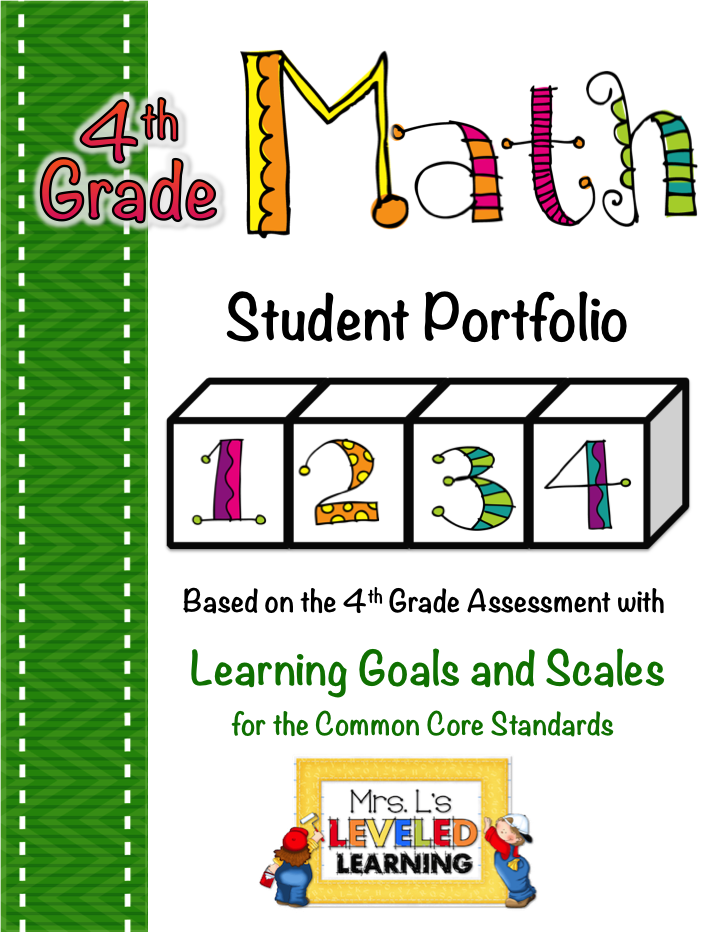
How nice would it be to have one organized place to display student performance data that explains itself! The Math Assessments with Learning Goals and Scales plus the free Student Portfolio Pages that go with each grade level, were created to be a visual tracking aid for documenting student progress in a really simple and consistent way. Click on the video link below to flip through the 4th Grade Portfolio Sample that Tonya used for parent-teacher conferences. Visit my FREEBIES page to try them out for yourself first. Grades 3-8 are available now. Check out the work samples below!


If you'd like to see a quick tutorial about how to put together the math assessment binder with the Student Portfolio pages, visit my YouTube playlist. 


Saturday, March 14, 2015

Make Differentiation Easy with Learning Goals and Scales

Differentiation can seem overwhelming when you think about having to plan for 3 or 4 different levels all at the same time. I used to think about differentiation as far as high and low, but that was about it. Often I didn't end up modifying that much and I definitely didn't keep track of who started where or how far they'd progressed. Differentiation seemed like a luxury, that I didn't have time for. Until I learned to plan ahead in a more detailed way. Research shows that students who start with clear and specific learning goals can concretely SEE their progress, and will show more learning at testing time! This sounds great, but how do you organize multiple levels of performance?


Learning Goals and Scales can help!

When you create a scale, each learning goal is broken down into five levels, from 0-4. Proficiency in each math standard is represented by a score of 3. A score of 4 indicates an advanced knowledge of the skill, usually above grade level. The goals assigned to scores of 2 and 1, are either derived from sub-skills of the standard, or from the background knowledge of earlier grade levels. A score of 0 on the learning scale is useful to document for students who really need intervention to grow.

It takes some time and some thinking to put them together at first, but once it's done, it's done!! You can create scales for any subject area and make them a little more general ("I can perform any fraction operation.") or more specific ("I can add and subtract fractions with different denominators.") I found math to be the most difficult to differentiate for, so I spent the most time creating them. I also chose to focus on the standards as my main learning goal so that I wouldn't have to create a separate one for each discrete skill!
                                                                 Here's an example:

When I started posting Learning Goals with Scales for our math standards, it became more obvious to them where they were starting from and where we were headed.  

We started by informally deciding where they were based on their own opinion; "Show me on your fingers if you think you are a 1-2-3-4 right now." This worked fine to get them used to the idea, but wasn't helping me to assess or plan as much until I created some concrete Assessments with Learning Goals and Scales which presented specific tasks for each level 0-1-2-3-4, so the kids had a way to show what they knew already. I spent over 120 hours creating Math Assessments with Learning Goals and Scales for grades 4, 5, and 6, which I was currently teaching the most. I spent these hours reading, researching, and creating Learning Goals and scales for each standard that drew from previous grade levels and future grade level skills. Since I had taught so many different grade levels of math, I had a good idea where to look for standards that progressed.You can see examples of Mrs. L's Assessments by visiting my blog: http://mrslsleveledlearning.blogspot.com

I can't tell you how proud and happy they were to SEE their progress and feel like they had more than one chance to master it!!


Here's the 3 biggest benefits I found from using learning goals with scales...

1. Kids and parents will know exactly where learning and grades are coming from! After every single test, as if it were some unwritten ritual, students would brag, hide, and compare their test scores. Sound familiar? The most painful thing is to see those little jaws drop and faces turn red when they didn't score as well as they thought. "But, why did I get a 'C' Mrs. LiCausi?" (Even B's were a disappointment to those high-achievers!) I received a lot fewer questions from students, parents, and administrators when I could point out the progression of skills that a student had mastered or not, to get them to that place. When scales are aligned to specific grades, students can make a clear connection to their level of mastery and their final grade.
Visit my website to see an example of how to align traditional percentages to scales for grading!

2. Clear and specific guide for planning and assessing student progress. If you aren't lucky enough to work for a district that thoroughly plans your curriculum and mapping guides, then you know the painfully time-consuming process of sitting down with a year's worth of standards and trying to organize all those ideas, and break them down into manageable chunks for your students. The school year gets busy fast, and every time you switch topics and pre-assess your students, you're starting all over to figure out how to teach them where they're at, differentiating for different levels, and assessing again. If you've got learning goals and scales in order, the process goes so much faster because some of the thinking is done for you! You can move onto the fun part like planning and searching for awesome lessons!

3. Research supports it! Check out some of the following citations...

"The starting place for all effective instruction is designing and communicating clear learning goals."

"If teachers aren't sure of instructional goals, their instructional activities will not be focused, and unfocused instructional activities do not engender student learning.

 - Marzano [2009]


"Our collective goal is that the largest possible percentage of our students get there. To reach that goal we must define for ourselves and for them where "there" is. "

- Stiggins [1994]

"Learning targets convey to students the destination for the lesson - what to learn, how deeply to learn it, and exactly how to demonstrate their learning. In our estimation [Moss & Brookhart, 2009] and that of others [Seidle, Rimmele, & Prenzel, 2005; Stiggins, After, Chappuis & Chappuis, 2009], the intention of the lesson is one of the most important things students should learn. Without a precise description of where they are headed, too many students are "flying blind."

- Moss, Brookhart, Long [2011] Knowing Your Learning Target. Educational Leadership.  
68 [6]. pp.66-69.


Who has time to waste on ineffective approaches? 


Thursday, February 26, 2015

Do Your Students Act Like Getting an A is a "Lucky" Day?


 Linking up with Getting Nerdy with Mel & Gerdy today for Secondary Sunday FREEBIES!

Click my FREEBIES tab above to find free samples of every resource I use to help 
kids assess and track their own progress with Learning Goals and Scales. 

Sometimes kids act like getting a A+ is like hitting the jackpot, and I would think, Wow It's great to see them light up and get so excited! They are so proud of themselves, and so happy with their accomplishments. Usually it was the same kids over and over. Then there were the other ones who never received As. I could see in their faces that they stopped getting excited a while ago. What's the problem with this picture?
I realized that my students had NO IDEA 
where their grades came from! 


Some kids might attribute it to "being smart" or say that "school is just easy for me." Other kids would say that they were dumb, or that I didn't like them as much. Getting an A was "lucky" and some kids were just never that lucky. I wanted to communicate to them that getting an A has nothing to do with luck - it has to do with CHOICES.
"I choose to...

...pay attention in class."
...use my time productively."
...ask questions when I don't understand."
...learn from other students who do get it."
...ask myself questions about what I understand."
...complete practice assignments like homework, before the test date!"
...be aware of my strengths and weaknesses so I know when I need help and when I don't."
...persevere when something feels tough or takes a long time."

Notice, none of these statements have anything to do with intelligence! Of course it can be a factor, but most of the time these choices have become habits of good students; and unfortunately aren't practiced by their lower-performing peers.

How can we help kids make this connection that their accomplishments 
are directly related to their choices, and not luck?
Marzano & Haystead's research shows that students perform up to 34 percentiles more when they have clear and specific goals and track their progress in some progressive way.


I noticed a difference in my student's attitudes as well as performance when we began using specific learning goals with scales and tracking their progress in student portfolios. The kids got to SEE their progress, specific examples of the content they were expected to master, and how each level in a scale related to their grades. My district had assigned a specific grading percentages to each scale so that grading became really quick and easy as well! Read more about Grading Scales here.

If you click on my FREEBIES tab, you'll find FREE copies of the Student Portfolio pages, and some Posters and Assessment samples with scales as well. These free materials are a great way to get ideas and get scales going in your classroom!

Thanks for stopping by!


Monday, February 2, 2015

What Can Marzano Scales Do for Gifted and Talented Students?


This week I am attending the 41st Annual AAGT Conference in Phoenix, AZ! 

I had the pleasure and sometimes anxiety of working with gifted and advanced students for 5 1/2 years in my last school district. It was a unique position because I was traveling between two Title I schools where the qualified gifted populations were small, and sometimes struggling to sustain services. In order to keep classes large enough, we experimented with adding high-ability students who weren't scoring high enough to have "gifted" status, but seemed to have a lot of potential to advance.

When I started using learning goals and scales with my 4th & 5th grade multiage math classes, I felt like they were helping me more than the kids. Defining each level of a scale meant that I could quickly plan differentiation for the limited class time I had. Having students who were gifted and high, for two grade levels meant that I had a wide variety of skills, even in these advanced classes.


After we established a routine of referring to and tracking the kid's progress in scales, I saw the benefits for them as well.

1. Accountability- Unfortunately not all children capable of learning quickly are motivated to work! There are multiple reasons and theories why this can be true, but if you've worked with gifted kids, you know that they aren't always the best students. Finishing assignments, staying organized, coping with challenges or perfectionism, emotional or social troubles, can distract them from achieving as much as they are capable of, or mastering the skills that you are interested in having them focus on (primarily the standards).

2. Differentiation- Sometimes teachers assume that a qualified gifted or talented student will be good at everything. They may even assume that they don't have to worry about their progress all year because they will do fine no matter what - not so! These kids are as varied in skills and strengths as anyone else in their classroom and have to be treated as individuals. Even a student who is "gifted" in a specific area, such as math or language arts, they may not have mastered every skill in that area. I had gifted language kids who had amazing vocabularies and profound comprehension, but they really struggled to write fluently. I had math students who were so quick with figures and mental computations, but struggled with word problem application or isolated topics like algebra or geometry. They need differentiation too, and being able to specifically identify their areas of need saves valuable classroom teaching time and can keep them motivated. They get the chance to consistently work on things that they really haven't mastered. This could mean that they move into a scale from the next grade level, or deepen their knowledge and application of grade-level skills.

3. Affirmation! Most gifted and talented kids know that they are smart, but outside of individual projects they don't often have opportunities to display how much they've learned! Sometimes a really advanced student will enter your room already knowing most of the grade-level curriculum, meaning that the usual curriculum and assessments aren't going to show their true growth as a learner. These kids deserve resources to keep them moving forward just as much as any other student. I have found that the scales, which include advanced skills, help these students to pin point where they are going next and affirm that they are learning new things too!

If you'd like to learn more about using Learning Goals with Scales in your room,  there is a quick video tutorial available on my YouTube Playlist -
How to Use Learning Goals with Marzano Scales.

Below are examples of the Student Portfolio Binders I used to track and sort students' Assessments and work. You can get these Portfolios by following the link to my "FREEBIES" page. Grades 3-8


Tuesday, January 27, 2015

Geometry with Origami - Movie Clip Monday Linky!

Techie Turtle Teacher has started a fun new linky party called "Movie Clip Monday." I loved using video clips in my classroom because it helps students to visualize concepts and reinforce verbal explanations. What a great idea to share ideas and save each other some time scanning the web for the best ones.

A few days ago I posted my FREE Geometry quizzes for Grades 3-8. I wrote about a vocabulary illustration assignment that I used in my classroom to help students make creative associations between the plethora of vocal terms, and the visual geometric representations for each one. Follow this link to read my previous post and enter my weekly Raffle!

Today I'd like to share a website with multiple video clips that illustrate folding techniques for origami projects. Kids LOVE this!!!! I have always loved origami, but in the past teaching my students with the step-by-step diagrams was very difficult for most. These video clips are awesome because they animate each fold and you have the option of repeating the demonstration, speeding it up, sowing it down, or playing it in reverse!

Here are some project ideas for Valentines Day from Origami Club. The stars indicate the level of difficulty. The menu to the left gives other categories of projects. (animation) means there's a video.

Things to keep in mind when using origami for geometry:
1. Know what you want to teach! The Common Core Geometry standards vary widely for each grade level and aren't necessarily in sequence; meaning 4th graders for example, are learning about angles for the first time with little to no prior knowledge or vocabulary. I always found it helpful to have a list of vocabulary words or concepts posted along my front board so I could remind myself what to refer to.

Your vocal/concept list might include: symmetry, lines, angles, polygon shapes, or transformations. There are so many things you can point out while working through the steps!

2. Partner kids with different competencies. Some kids really take to the 3-D visualization of paper-folding, and others do not get it. There's no way to get around the room to help every kid who gets stuck on the first step. Partner them with a peer or in small groups so that there's at least one confident student who can help the others. You can simply ask kids who has done origami before, or do a few quick test directions to see who is following along quickly and easily. 

These are a couple of origami models I would keep in the classroom to spark curiosity. The cube required 12 pieces of paper, and the star polyhedron required 30!


Thanks for stopping by and enjoy trying these videos with your class!!!


Tuesday, October 7, 2014

5 Steps to Creating Successful Common Core Scales for Student Learning


Linking up with Middle School Math Moments for Working on It Wednesday!

Is it just me, or is it a little bit time-consuming to create unique scales? The following article gives a 5-step process to create your own scales for any learning goal you choose.  This might be helpful if you're just starting out and trying to understand what each scale means.

5 Steps to Creating Successful Common Core Scales for Student Learning - 
                                         Learning Sciences Marzano Center

What I find much most difficult is deciding what content or sub-goal should be at each scale under the primary goal. When I am developing assessments, I usually define each sub-goal as a sub-skill or previous grade level skill that they would've needed to master first.
I have completed Grades 4-8, 
including the FREE Standards sets, Posters, and Portfolio pages! Yeah! 
I am still working on third grade. Here's some examples of 3.OA.6 and 3.OA.7.


I liked the ease of using a general scale, but felt like it wasn't enough for my students to be clear about how much they knew. I wanted to create specific scales as suggested in the article above. The Assessment helps to define each level with examples for the students. The posters give students a visual reminder of the scale for each standard.  By the end of this month I will be done with the Assessment, the Posters, and the FREE Portfolio Pages for tracking student progress. If you click the "Follow Me" star you will receive notices when products are published or revised.

Visit my store for a free sample of the Assessment with Common Core Standards 3.NBT.1, 3.NBT.2, & 3.NBT.3!

Thanks for stopping by!


Related Posts Plugin for WordPress, Blogger...

Pop-Up Sign-up form